
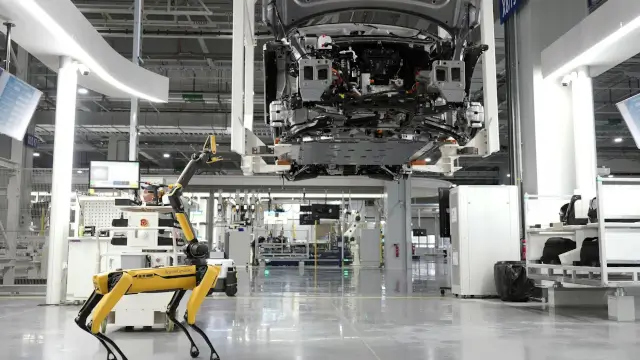
Physical AI — the integration of artificial intelligence with physical hardware — is no longer a laboratory experiment. In 2026, robots powered by foundation models are walking factory floors, inspecting power grids, assisting in surgery, and working alongside humans in warehouses. Jensen Huang of NVIDIA calls it "the next wave of AI" after perception AI, generative AI, and agentic AI. The global Physical AI market, covering autonomous robots, humanoid systems, self-driving vehicles, and AI-enabled industrial systems, is projected to grow from approximately $383 billion in 2026 to $3.26 trillion by 2040, representing one of the largest technology market expansions in history.
What Is Physical AI and Why Does It Matter in 2026?
Unlike digital-only AI — which processes text, images, and data — Physical AI operates in and interacts with the real world through robotic embodiment. It combines computer vision, natural language understanding, and physical action planning into unified systems that can perceive, reason, plan, and execute tasks in unstructured environments.
Three breakthroughs in 2025-2026 transformed Physical AI from a long-term vision into a deployable technology:
- Robot Foundation Models — Large-scale models like NVIDIA's GR00T (Generalist Robot 00 Technology) and Google DeepMind's Gemini Robotics enable robots to understand natural language, observe human actions, and translate them into physical movements without task-specific programming.
- GPU-Accelerated Simulation — NVIDIA Isaac Sim and Omniverse allow robots to train millions of hours in virtual environments, using domain randomization so policies transfer flawlessly to real hardware.
- Humanoid Hardware Maturation — Mass production costs for general-purpose robots are approaching commercial viability, with manufacturing costs dropping 40% between 2023 and 2024.
The $383 Billion Physical AI Market: Numbers That Demand Attention
The market statistics for Physical AI in 2026 are staggering:
- Physical AI market (encompassing autonomous robots, self-driving vehicles, humanoids, industrial automation, and AI-enabled systems): $383 billion in 2026, projected to reach $3.26 trillion by 2040
- Embodied AI market (focused on AI integrated with physical systems): valued at $3.8 billion in 2026, growing to $7.24 billion by 2030 at 17.5% CAGR
- Humanoid robot market: $6.24 billion in 2026, projected to reach $165.13 billion by 2034 at an explosive 50.60% CAGR
- Installed humanoid units worldwide: 16,000 units by early 2026, projected to hit 2 million by 2035 and 300 million by 2050
- Cumulative industry funding: surpassed $9.8 billion by 2025, with over 150 humanoid robot companies active globally
- Humanoid robot market value by 2050: estimated between €1.3 trillion and €1.6 trillion
Humanoid Robot Leaders: Tesla Optimus, Figure 02, and the Race for Real-World Deployment
Figure 02 is currently the only humanoid robot proven in commercial manufacturing. Deployed at BMW's Spartanburg factory, Figure's robots handle complex assembly tasks and have accumulated thousands of operational hours, providing invaluable real-world training data. Figure AI's valuation reached $39 billion after raising $1 billion in September 2025.
Tesla Optimus Gen 3 has entered trial production. Tesla deployed over 1,000 Optimus units in its own factories by January 2026, with plans to scale to 50,000 by year-end. Elon Musk aims to bring per-unit cost below $20,000, which would transform humanoid robots from high-end equipment into general labor commodities. Optimus Gen 3 features Tesla-designed actuators, faster hands, articulated neck, and significantly reduced weight.
Agibot (China) led global shipments in 2025, delivering 5,100 units with a 39% market share from its Shanghai facility. The company declared 2026 as "Deployment Year One" and unveiled new embodied AI robots at AGIBOT APC 2026.
Apptronik raised $520 million in February 2026, backed by Google and Mercedes-Benz, at a $5 billion valuation for its industrial humanoid Apollo.
NVIDIA's Full-Stack Physical AI Ecosystem: Cosmos, GR00T, and Isaac
NVIDIA is the central infrastructure provider for the entire Physical AI industry:
- NVIDIA Cosmos — World foundation models for generating synthetic training data. Cosmos Reason 2 brings reasoning VLMs into the physical domain.
- Project GR00T — Generalist Robot 00 Technology, a foundation model enabling humanoid robots to understand language and learn from human demonstration.
- NVIDIA Isaac Sim — GPU-accelerated simulation built on Omniverse, supporting PhysX engine, ray-traced rendering, and massive parallelization for training robot policies.
- NVIDIA Jetson Thor — Next-gen robotics processor delivering 1,200 FP4 TFLOPS within a 70-watt power envelope at ~€1,900 per unit for volume orders.
- RTX PRO 6000 Blackwell — GPUs for training large-scale robot foundation models.
At NVIDIA GTC 2026, the company partnered with global robotics leaders including FieldAI, Skild AI, and Agibot to bring Physical AI to the real world, providing Cosmos world models for data generation and Isaac for validation.
Vision-Language-Action (VLA) Models: The Brains Behind Physical AI
The key architectural innovation driving Physical AI in 2026 is the Vision-Language-Action (VLA) model. These models combine computer vision, language understanding, and physical action planning into a single neural architecture:
- OpenVLA — Open-source VLA model enabling robots to perform diverse manipulation tasks from natural language commands
- Google DeepMind Gemini Robotics-ER 1.6 — Enhanced embodied reasoning and instrument reading for physical tasks
- π0 (Pi-Zero) — A general-purpose policy model for real-world robotic control
- GEN-1 by Generalist AI — Claimed breakthrough in real-world robot task performance, unveiled April 2026
- RT-2 and successors (DeepMind) — Allow robots to reason about tasks they've never been explicitly trained on
These models mark a fundamental shift from task-specific robot programming to general-purpose embodied intelligence, where a single model can handle pick-and-place, assembly, navigation, and social interaction.
Real-World Applications: Where Physical AI Works Today
Manufacturing and Warehousing — Accenture, Vodafone, and SAP are piloting humanoid robots in warehouse operations. BMW's Spartanburg factory runs Figure 02 robots on production lines. Tesla factories use Optimus for internal logistics and repetitive tasks.
Industrial Inspection — ANYbotics' quadruped robots inspect power grids, oil refineries, and hazardous industrial sites. The company turned industrial inspections into actionable business insights through SAP integration in 2026.
Healthcare and Surgery — Physical AI systems assist in minimally invasive surgery with sub-millimeter precision. Embodied AI robots are being developed as healthcare aides for elderly care and hospital logistics.
Agriculture — AI-powered agricultural robots handle crop monitoring, harvesting, and precision spraying. Luminous Robotics and Terra Robotics (NVIDIA Inception members) are developing specialized agricultural systems.
Logistics and Supply Chain — Autonomous mobile robots (AMRs) equipped with Physical AI navigate warehouses, sort packages, and coordinate with human workers. The market for warehouse robotics is growing at over 30% annually.
China's Embodied AI Push: The Five-Year Plan and Global Competition
China's central government has explicitly listed robotics as a strategic priority in its 2026-2030 Five-Year Plan. The country's approach mirrors its solar industry strategy: aggressive volume production even at the expense of near-term profitability, aiming to dominate global humanoid manufacturing.
Key Chinese developments:
- Agibot: 5,100 units shipped in 2025 (39% global market share); open-sourced the Agibot World 2026 dataset to accelerate embodied AI development
- Deep Robotics: Raised $68M Series C for industrial-grade all-weather humanoid DR02
- AI² Robotics: Raised $145M+ Series B for AlphaBot wheeled humanoids with VLA models
- Record funding in Q1 2026: Chinese embodied AI companies raised record venture capital, with IPO momentum building
Analysts at MERICS (Mercator Institute for China Studies) published a detailed report on China's ambitious path to transform its robotics industry through embodied AI, warning that Western companies could face Chinese competition priced below cost.
Challenges Facing Physical AI: Data, Safety, and Infrastructure
Despite the rapid progress, Physical AI faces significant hurdles:
- The Data Problem — Training robot foundation models requires millions of real-world demonstrations, which are far harder to collect than internet text data. Synthetic data from simulation helps but still suffers from the sim-to-real gap.
- Safety and Security — UC Santa Cruz researchers demonstrated in January 2026 that misleading text in the physical world can hijack AI-enabled robots. Recorded Future published a report on "Hacking Embodied AI" in May 2026, highlighting new attack surfaces.
- Infrastructure Requirements — CIO.com identified 5 critical infrastructure components for Physical AI: edge computing, 5G connectivity, digital twins, real-time data pipelines, and safety-certified hardware.
- Regulatory Frameworks — Governments worldwide are developing safety standards for autonomous physical systems. CSET at Georgetown University published a comprehensive analysis of Physical AI policy implications in February 2026.
- Cost Barriers — While costs are dropping, humanoid robots still require significant CAPEX. The path to sub-$20,000 humanoids depends on manufacturing scale that will take years to achieve.
The Future: From Pilot to Platform
The transition from prototype to production is accelerating. KraneShares notes that humanoid robotics is moving "from pilot to platform," with 16,000 installed units worldwide in early 2026 and projections reaching 2 million by 2035. Jensen Huang's CES 2026 address positioned Physical AI as the inevitable evolution: perception AI → generative AI → agentic AI → Physical AI.
By 2050, analysts project 300 million humanoid robots in operation, creating a market valued at €1.3-1.6 trillion. The winners in this space will be determined not just by AI capability but by manufacturing scale, deployment data, regulatory speed, and supply chain control.
As the Deloitte 2026 Tech Trends report concludes: "Robots powered by physical AI are no longer confined to research labs or factory floors. They're inspecting power grids, assisting in surgery, navigating city streets, and working alongside humans in warehouses. The transition from prototype to production is happening now."