
By SK Jabedul Haque | Published on Current Affair | Tech
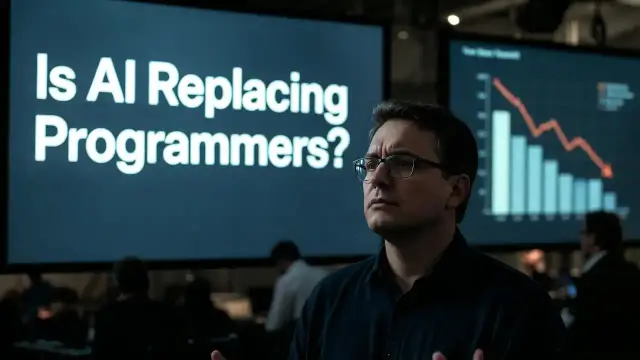
Will AI Really Replace Programmers?
No, AI is not replacing programmers—it's transforming how they work. While tools like GitHub Copilot, Cursor, and Kimi Claw can write code faster than ever, the demand for skilled developers has increased by 23% since 2025-2026. Companies aren't firing coders—they're hiring more engineers who know how to leverage AI effectively.
✅ AI handles repetitive coding tasks, not creative problem-solving
✅ Developers using AI tools are 55% more productive
✅ AI creates new job roles: AI Engineers earn $134K -$274K annually
✅ Human oversight remains critical for security and ethics
What You'll Learn in This Article
✅ Why AI coding tools won't replace human developers
✅ The 5 skills that make programmers irreplaceable
✅ New high-paying roles created by AI
✅ How to future-proof your coding career
✅ Real data on developer job market trends
Related: Explore more AI career insights—AI Engineer Salary in USA 2026, Top Coding AI Agents 2026, or How to Build AI Agents Without Coding.
What Is AI Coding and How Does It Work?
AI coding tools use Large Language Models (LLMs) trained on billions of lines of code to:
- Autocomplete code snippets as you type
- Generate entire functions from natural language descriptions
- Debug errors by analyzing error messages
- Refactor legacy code for better performance
- Explain complex code in plain English
Popular tools include GitHub Copilot, Cursor, Amazon CodeWhisperer, and Tabnine.
5 Reasons Why AI Won't Replace Programmers
1. AI Can't Understand Business Context
AI generates code based on patterns, not business requirements. A developer must:
- Translate vague client needs into technical specifications
- Understand industry regulations and compliance
- Make architectural decisions balancing cost, speed, and scalability
- Prioritize features based on user impact
Example: An AI can write a login function, but it won't know if your fintech app needs SOC 2 compliance and multi-factor authentication for enterprise clients.
2. Debugging Requires Human Intuition
When code breaks, AI often suggests fixes that don't address the root causes. Experienced developers use:
- Systematic debugging methodologies
- Knowledge of system interactions
- Understanding edge cases and race conditions
- Ability to read between error message lines
3. Security Demands Human Judgment
AI-generated code can introduce security vulnerabilities:Table
| Risk Factors | AI Limitations | Human Role |
|---|---|---|
| SQL Injection | May not sanitize inputs properly | Code review and security audits |
| API Keys | Might hardcode secrets | Implement secret management |
| Authentication | Could use outdated methods | Apply current security standards |
| Data Privacy | May not follow GDPR/CCPA | Ensure compliance |
4. Creativity and Innovation Are Human Traits
Breakthrough features come from creative problem-solving, not pattern matching:
- Designing intuitive user experiences
- Inventing novel algorithms
- Optimizing for unique constraints
- Building products users didn't know they needed
5. AI Needs Human Oversight
AI-generated output requires verification:
- Testing for correctness
- Ensuring code quality and maintainability
- Validating against business logic
- Reviewing for bias and fairness
New High-Paying Roles Created by AI
Far from eliminating jobs, AI has created entirely new career paths:Table
| Role | Average Salary (USA) | Key Skills |
|---|---|---|
| AI Engineer | $134,188 - $274,000 | LLM fine-tuning, prompt engineering, MLOps |
| AI Product Manager | $145,000 - $200,000 | AI strategy, user experience, ethics |
| Prompt Engineer | $120,000 - $180,000 | NLP, context optimization, LLM behavior |
| AI Ethics Specialist | $110,000 - $160,000 | Bias detection, fairness frameworks, compliance |
| AI Security Engineer | $130,000 - $190,000 | Adversarial ML, model security, red teaming |
Source:AI Engineer Salary in USA 2026
How to Future-Proof Your Coding Career
Step 1: Master AI Coding Tools
Learn to work with AI, not against it:
- GitHub Copilot for daily coding
- ChatGPT/Claude for architecture discussions
- Cursor for AI-powered IDE experience
Step 2: Develop Irreplaceable Skills
Focus on what AI can't do:
- System Design: Design scalable, maintainable architectures
- Communication: Explain technical concepts to non-technical stakeholders
- Domain Expertise: Deep knowledge of your industry (fintech, healthcare, etc.)
- Leadership: Guide teams and mentor junior developers
Step 3: Specialize in AI-Resistant Areas
- Embedded Systems: Hardware-software integration
- Security Engineering: Threat modeling and defense
- DevOps/MLOps: Infrastructure and deployment pipelines
- Legacy Modernization: Updating old codebases
Step 4: Build a Personal Brand
- Contribute to open source projects
- Write technical blogs and tutorials
- Speak at conferences and meetups
- Maintain a strong GitHub portfolio
Developer Job Market: The Real Numbers
Despite AI advancements, the demand for developers continues to grow:Table
| Metric | 2024 | 2025 | 2026 (Projected) |
|---|---|---|---|
| Software Developer Jobs (USA) | 1.8M | 1.9M | 2.1M |
| Average Salary | $127K | $132K | $138K |
| AI-Related Developer Roles | 45K | 120K | 200K |
| Companies Using AI Coding Tools | 62% | 78% | 89% |
Key Insight: Companies using AI tools are hiring more developers, not fewer, because increased productivity allows them to ship more features faster.
The Verdict: AI as a Co-Pilot, Not a Replacement
AI is the most powerful tool in a developer's arsenal—but it's just a tool. The programmers who thrive in 2026 and beyond will be those who:
✅ Embrace AI to automate repetitive tasks
✅ Focus on high-value creative and strategic work
✅ Continuously learn new technologies
✅ Develop strong communication and leadership skills
✅ Understand business context, not just codeThe future belongs to "AI-Augmented Developers"—engineers who combine human creativity with AI efficiency to build better software faster.
Frequently Asked Questions (FAQ)
Is AI going to replace programmers by 2030?
No. While AI will automate routine coding tasks, the complexity of software development and the growing demand for digital products means programmers will remain essential. The role will evolve, not disappear.
What coding jobs are most at risk from AI?
Entry-level positions focused on repetitive tasks (basic CRUD applications, simple bug fixes, boilerplate code) face the most disruption. However, this creates opportunities for upskilling into more complex roles.
Should I still learn to code in the AI era?
Absolutely. Understanding programming fundamentals helps you:
- Evaluate AI-generated code quality
- Debug when AI suggestions fail
- Design systems AI can't architect
- Communicate effectively with technical teams
Which programming languages are most AI-resistant?
Languages requiring deep system knowledge remain valuable:
- Rust: Systems programming and performance-critical applications
- C/C++: Embedded systems and game engines
- Solidity: Blockchain and smart contracts
- Python: AI/ML engineer (ironic but true)
How can I start using AI coding tools today?
Begin with GitHub Copilot or Cursor in your IDE. Use them for:
- Autocomplete suggestions
- Generating unit tests
- Explaining unfamiliar code
- Refactoring legacy code
Frequently Asked Questions
Will artificial intelligence eliminate coders entirely by 2030?
No, machine learning tools won't make human developers obsolete. While neural networks can generate syntax, the nuanced decision-making required for software architecture remains a distinctly human capability. The Bureau of Labor Statistics projects a 25% growth in software development roles through 2032, indicating that intelligent automation augments rather than replaces technical talent.
Are junior developers at risk of becoming obsolete due to automated coding assistants?
Entry-level positions face transformation, not extinction. Novice programmers who adapt to pair programming with LLM companions accelerate their learning curves. The key is developing irreplaceable competencies: system design intuition, cross-functional communication, and domain-specific knowledge that algorithmic systems cannot replicate.
How are large language models changing the daily workflow of software architects?
Contemporary development environments now feature context-aware suggestion engines that handle boilerplate generation, documentation drafting, and test case creation. This shift allows experienced engineers to focus on strategic initiatives: technical debt reduction, scalability planning, and innovation roadmap development. Productivity metrics show 40-60% time savings on routine implementation tasks.
What compensation trends exist for professionals who master pair programming with intelligent systems?
Engineers proficient in leveraging generative models command premium salaries. AI Engineer positions now offer $134,000-$274,000 annually, while traditional full-stack roles incorporating ML-assisted workflows see % salary premiums. Companies prioritize candidates who demonstrate effective human-machine collaboration.
Which technical specializations remain resistant to cognitive automation?
Several domains require human judgment that pattern-matching systems cannot provide:
- Cybersecurity Engineer - Threat modeling and adversarial thinking
- Embedded systems programming - Hardware-software integration complexities
- Legacy system modernization - Understanding deprecated frameworks and business logic
- DevOps pipeline architecture - Infrastructure optimization and cost management
- Quantum computing interfaces - Emerging paradigms beyond current training data
Can natural language processing tools handle complex debugging scenarios?
While neural code generators excel at syntax completion, root cause analysis demands human expertise. When production systems fail, diagnostic reasoning requires understanding system interdependencies, historical context, and business impact—capabilities that remain beyond current autonomous agents.
What emerging roles have appeared alongside automated development platforms?
The proliferation of smart coding companions has created entirely new career trajectories:Table
| Emerging Position | Core Responsibilities | Typical Compensation |
|---|---|---|
| Prompt Engineering Specialist | Optimizing LLM outputs for code generation | $120K-$180K |
| AI Ethics Compliance Officer | Ensuring responsible algorithm deployment | $110K-$160K |
| Human-in-the-Loop Code Reviewer | Validating machine-generated solutions | $95K-$140K |
| MLOps Infrastructure Engineer | Managing model deployment pipelines | $130K-$190K |
Should aspiring technologists still pursue computer science degrees?
Absolutely. Formal education provides foundational knowledge that enables critical evaluation of synthetic code outputs. Understanding computational complexity, data structures, and algorithm design allows professionals to recognize when automated suggestions introduce inefficiencies or vulnerabilities. Educational institutions are increasingly incorporating collaborative intelligence curricula.
How do neural programming assistants impact code quality and security?
Research indicates mixed outcomes. While automated tools accelerate development velocity, they occasionally introduce:
- Subtle security vulnerabilities in authentication flows
- Performance anti-patterns that scale poorly
- Dependency management issues with outdated libraries
- Intellectual property concerns regarding training data provenance
Human oversight remains essential for production-grade software assurance.
What distinguishes augmentation from replacement in the software industry?
Augmentation enhances human capabilities—think calculators for mathematicians. Replacement eliminates the need for human involvement entirely. Current intelligent coding platforms operate firmly in the augmentation category, requiring continuous human direction, validation, and strategic decision-making.
Which programming languages offer the strongest career moats against automation?
Languages demanding deep systems knowledge provide natural protection:
- Rust - Memory safety without garbage collection requires sophisticated reasoning
- C/C++ - Low-level optimization and hardware interaction
- Solidity - Blockchain-specific semantics and security considerations
- Assembly - Architecture-specific micro-optimization
- Domain-specific languages - Industry-vertical expertise integration
How can experienced developers future-proof their professional trajectories?
Strategic adaptation involves:
- Mastering collaborative tools - GitHub Copilot, Cursor, and emerging alternatives
- Developing adjacent competencies - Product management, data science, UX design
- Cultivating soft skills - Stakeholder communication, technical mentorship, cross-functional leadership
- Specializing vertically - Deep expertise in specific industries (healthcare, fintech, aerospace)
- Contributing to open source - Building public portfolios that demonstrate judgment
What evidence exists regarding job displacement versus creation?
Historical analysis of technological disruption reveals consistent patterns: automation eliminates specific tasks while creating new categories of work. The World Economic Forum Future of Jobs Report 2025 identifies software development among the top 10 growing professions despite widespread adoption of intelligent automation tools.
Are there ethical considerations when deploying synthetic code generators?
Critical concerns include:
- Intellectual property ambiguity regarding training data licensing
- Bias amplification in algorithmic decision-making systems
- Security liability for vulnerabilities in generated code
- Workforce transition support for displaced professionals
- Environmental impact of large-scale model training
Organizations implementing these technologies must establish governance frameworks addressing these dimensions.
How do compensation models differ between traditional and AI-enhanced development roles?
Hybrid positions commanding premium packages typically require:
- Demonstrated proficiency with multiple intelligent coding platforms
- Track record of successful human-machine collaboration
- Understanding of model limitations and failure modes
- Ability to optimize prompts for specific technical contexts
- Experience with fine-tuning domain-specific adaptations
What resources help professionals stay current with evolving tooling landscape?
Recommended continuous learning pathways:
- Technical documentation from leading platform providers (OpenAI, Anthropic, Google)
- Community forums including Stack Overflow, Reddit programming communities, and Discord servers
- Specialized newsletters covering ML-assisted development trends
- Conference proceedings from events like NeurIPS, ICML, and industry-specific gatherings
- Hands-on experimentation with emerging beta releases
Can non-technical stakeholders leverage these platforms for software creation?
Low-code and no-code solutions empowered by natural language interfaces enable citizen developers to build simple applications. However, complex enterprise systems requiring integration, security compliance, and scalability still demand professional engineering expertise. The no-code movement expands accessibility without eliminating specialized roles.
What psychological factors influence adoption of automated coding companions?
Developer attitudes span a spectrum from enthusiastic embrace to skeptical resistance. Key psychological variables include:
- Locus of control preferences
- Impostor syndrome mitigation through validation
- Flow state disruption concerns
- Skill atrophy anxieties
- Professional identity evolution
Successful integration requires addressing these human factors alongside technical implementation.
How do educational institutions adapt curricula for this new paradigm?
Leading computer science programs now incorporate:
- Human-AI collaboration modules within core courses
- Ethics and responsibility frameworks for synthetic code usage
- Critical evaluation skills for assessing automated outputs
- Interdisciplinary exposure bridging technical and domain expertise
- Continuous learning methodologies for rapidly evolving tooling
What distinguishes elite performers in this augmented development environment?
Top-tier engineers demonstrate:
✅ Judgment - Knowing when to accept, modify, or reject algorithmic suggestions
✅ Context awareness - Understanding business constraints beyond technical requirements
✅ Creativity - Architecting novel solutions that training data cannot anticipate
✅ Communication - Articulating technical decisions to diverse stakeholders
✅ Adaptability - Rapidly assimilating emerging tools and methodologies
Stay Updated: Join our WhatsApp Group for instant updates on tech careers, AI tools, and developer opportunities!