
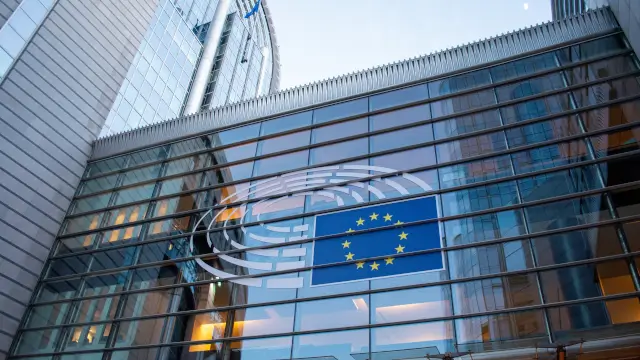
The EU AI Act’s primary enforcement phase begins on August 2, 2026, granting the AI Office full power to impose fines of up to €15 million or 3% of global turnover for GPAI violations. While basic obligations applied in 2025, the August 2026 "reality check" shifts from voluntary cooperation to mandatory technical documentation and transparency, with additional transparency deadlines for high-risk systems potentially shifting to November 2, 2026.
What You'll Learn
- ✅ Enforcement Power – Why August 2, 2026, is the "point of no return" for AI fines.
- ✅ GPAI Slabs – Understanding the 10²⁵ FLOPs threshold for systemic risk.
- ✅ The November Shift – How the "Digital Omnibus" package impacts your compliance timeline.
- ✅ Transparency Checklist – Mandatory labeling and copyright policy requirements.
- ✅ Compliance Roadmap – A 6-step guide to avoiding the €15M penalty tier.
Related: Explore — MCP & Vendor Lock-In, What is MCP?, or Agentic AI Security Risks.
By May 2026, the global AI industry has moved past the "honeymoon phase" of experimentation. For anyone deploying General-Purpose AI (GPAI) models in the European market, the clock is ticking toward a critical structural shift. While the EU AI Act was passed in 2024, its teeth only truly sink in during the second half of 2026.
The transition from August 2025 to August 2026 marks the move from "soft law"—a shift that has created a massive demand for AI governance specialists across the Union.—where companies collaborated with the AI Office on a voluntary basis—to "hard law," where non-compliance carries the weight of massive financial penalties. In this reality check, we analyze the specific legal and technical boundaries that change on August 2 and the recently proposed November 2 buffer for high-risk system transparency.
The August 2, 2026 Enforcement Cliff
If you are a provider of a GPAI model (like GPT-5, Claude 4, or Llama 4), you have technically been subject to Article 53 and 55 obligations since August 2, 2025. However, the first year was effectively a "pre-audit" period. During this time, the EU AI Office could request information, but its ability to enforce punitive measures was restricted.
Everything changes on August 2, 2026. This is the date when the AI Office’s full enforcement apparatus activates. For models placed on the market after August 2025, this is the hard deadline for full technical documentation and the mandatory "summary of training data" requirement. More importantly, this is the date when Tier 2 fines (up to €15 million) become a reality for GPAI providers who fail to meet transparency standards.
The November 2, 2026 Buffer: "Digital Omnibus" Impact
In early 2026, the European Parliament introduced a "Digital Omnibus" simplification package. While it doesn't remove the core obligations, it clarifies the compliance window for systems that were already on the market. Specifically, for high-risk AI systems (Annex III), the deadline for establishing conformity assessments and registration has been proposed as November 2, 2026.
For GPAI providers, this November deadline is primarily relevant for User Disclosure (Article 50). This rule mandates that any system interacting with humans, including autonomous AI agents, must disclose that it is an AI, unless it's obvious from the context. The November shift provides a 3-month "breathing room" for developers to implement watermarking and disclosure layers into their existing user interfaces without facing the August enforcement cliff.
GPAI Systemic Risk: The 10²⁵ FLOPs Boundary
In 2026, the AI Office uses a "compute-based presumption" to identify which models pose a systemic risk to the Union. If a model is trained using a cumulative amount of compute greater than 10²⁵ floating point operations (FLOPs), it is automatically categorized as high-risk. By May 2026, this includes the latest flagship models from OpenAI, Anthropic, and Google DeepMind.
Providers of systemic-risk models face much steeper obligations. Beyond basic technical documentation, they must perform mandatory adversarial testing, often aligned with the OWASP Top 10 for Agentic AI to ensure comprehensive security., conduct continuous model evaluations, and report any "serious incidents" to the AI Office within 24 hours. The August 2026 deadline is the moment these audits move from a spreadsheet exercise to a legal mandate.
Mandatory Documentation & Transparency Checklist
If you are a developer or enterprise using these models, here is the compliance checklist that must be finalized before the August enforcement window:
Technical Documentation (Annex XI)
Maintain detailed architectural diagrams, training methodologies, and energy consumption logs for the model.
EU Copyright Policy
Establish a formal policy to respect the Copyright Directive (2019/790), including opting out of training where requested by rights holders.
Training Data Summary
Publish a high-level summary of the datasets used for training the model, ensuring transparency without compromising trade secrets.
Use the AI Office's "Compliance Checker" tool (beta) to audit your model's current status. Most companies are failing the "Copyright Transparency" section because they lack a documented policy for handling EU-based opt-outs. Fixing this now is 100x cheaper than defending an enforcement action in 2027.
Final Verdict
The EU AI Act's enforcement reality kicks in on August 2, 2026. Whether you're a GPAI provider or an enterprise deploying AI, the window for voluntary cooperation is closed. Technical documentation, copyright policies, and transparency disclosures are now legally mandatory. Act before August 2 to avoid fines that can reach €15 million or 3% of global annual revenue.
Key Takeaways
- August 2, 2026, marks the activation of the AI Office's fining power for GPAI models.
- November 2, 2026, is the proposed deadline for existing high-risk system registration.
- Systemic risk is presumed for any model exceeding the 10²⁵ FLOPs compute threshold.
- Fines for GPAI non-compliance can reach €15 million or 3% of global revenue.
Last Updated: May 06, 2026 | Source: European Commission (Official Website)