
What You'll Learn
- Nutritional norms and the current Mid-Day Meal menu for government schools in 2026.
- Implementation of fortified rice and micronutrients to tackle childhood anaemia nationwide.
- How schools can register and use the 'School Nutrition Gardens' for fresh ingredients.
- Steps to track child nutrition data via the PM POSHAN Tracker and Aadhaar attendance.
PM POSHAN Scheme 2026: Reimagining Child Nutrition in India
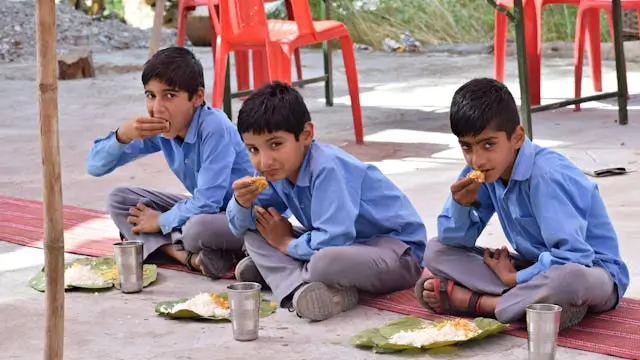
The PM POSHAN Shakti Nirman Yojana (formerly the Mid-Day Meal Scheme) is the world's largest school feeding program, covering over 11.80 crore children across 11.80 lakh schools nationwide. Renamed in 2021, the scheme provides a hot cooked meal to children in classes 1 to 8 in government, government-aided, and special training centres, including those in Bal Vatika (pre-primary). The scheme is jointly funded by the central government (60:40 ratio with states, 90:10 for NE states) and aims to improve nutritional status, school attendance, and social equity.
PM POSHAN Scheme 2026: Budget Allocation
For the financial year 2026-27, the government has allocated Rs 12,750 crore for the PM POSHAN scheme, an increase from Rs 12,500 crore in 2025-26. The Budget Estimate for 2025-26 was Rs 12,500 crore, with Revised Estimates at Rs 10,600 crore and actual releases of Rs 10,425.53 crore. The increased allocation in 2026-27 reflects the government's commitment to expanding coverage and improving meal quality. The scheme is 100 percent centrally sponsored for food grain costs, while cooking costs, honorariums, and management costs are shared in a 60:40 ratio between the Centre and states (90:10 for North-Eastern states).
Nutritional Norms and Menu Under PM POSHAN 2026
The nutritional norms under PM POSHAN specify a minimum of 450 calories and 12 grams of protein for primary classes (Bal Vatika and Classes I-V), and 700 calories with 20 grams of protein for upper primary classes (VI-VIII). The meal components include 100 grams of food grains for primary and 150 grams for upper primary students, along with pulses, vegetables, oil and fat, and condiments. The cooking cost has been revised from Rs 1.68 to Rs 2.50 per child per day for primary, and from Rs 2.20 to Rs 3.75 for upper primary classes.
| Component | Primary (Bal Vatika - Class V) | Upper Primary (Class VI-VIII) |
|---|---|---|
| Calories | 450 kcal minimum | 700 kcal minimum |
| Protein | 12 grams | 20 grams |
| Food grains | 100 grams | 150 grams |
| Cooking cost per day | Rs 2.50 | Rs 3.75 |
Fortified Rice Under PM POSHAN 2026
The government has been distributing fortified rice containing Iron, Folic Acid, and Vitamin B12 under PM POSHAN to address the widespread problem of anaemia among school children. The rice fortification initiative has been approved as a central sector scheme with 100 percent central funding, continuing until December 2028 with a total outlay of Rs 17,082 crore. However, in February 2026, the government temporarily discontinued fortified rice distribution under PMGKAY due to concerns about nutrient degradation during prolonged storage. The PM POSHAN scheme continues to use fortified rice from existing stocks, and the government is reviewing storage and distribution protocols to resume full-scale fortification.
School Nutrition Gardens Under PM POSHAN
Under the PM POSHAN scheme, schools are encouraged to develop School Nutrition Gardens (SNGs) to supply fresh, locally grown vegetables for mid-day meals. Detailed guidelines for setting up and maintaining SNGs have been issued to all states. These gardens help address micronutrient deficiencies and supplement the regular meal with fresh produce. As of 2026, over 4 lakh schools have established nutrition gardens, contributing fresh vegetables to daily meals and teaching children about sustainable agriculture. The vegetables grown include leafy greens, tomatoes, gourds, and seasonal vegetables, reducing the cooking cost while improving nutritional quality.
PM POSHAN Tracker and Aadhaar-Based Attendance 2026
The Poshan Tracker app, launched in 2021, enables real-time monitoring and tracking of all activities under the scheme. As of March 2026, the mission tracks nearly 14,03,170 Anganwadi Centres and approximately 8,95,29,425 eligible beneficiaries. The app allows Aadhaar-based authentication of beneficiaries and provides a 360-degree view of Anganwai Centre activities. The government has mandated Aadhaar-based attendance tracking to ensure that meals reach the intended beneficiaries and to eliminate ghost beneficiaries. The tracker generates real-time dashboards showing enrollment, attendance, meal distribution, and nutritional outcomes at the district, state, and national levels.
Cook-Cum-Helper Honorarium Under PM POSHAN 2026
The honorarium for Cook-cum-Helpers (CCHs) engaged under PM POSHAN varies significantly across states. While the central guideline provides a uniform honorarium of Rs 1,000 per month for 10 months, several states have enhanced this amount. Kerala pays up to Rs 12,000 per month, while some states still pay only the minimum. There have been ongoing demands from worker unions for a substantial increase in honorarium, with proposals suggesting a minimum of Rs 7,000 to Rs 11,000 per month. In 2025, some states increased the honorarium from Rs 2,000 to Rs 3,000, but unions continue to demand a nationwide revision.
Last Updated: May 31, 2026 | Source: Ministry of Education (Official Website)