
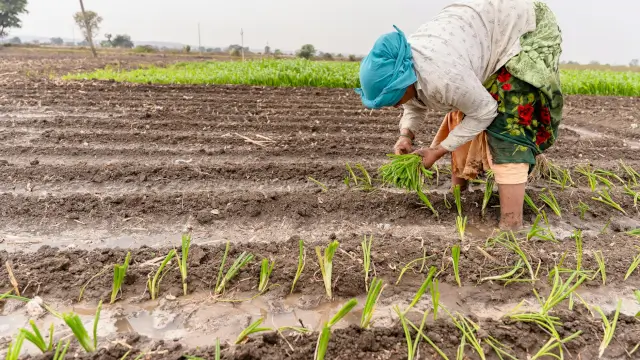
PMFBY 2026 Overview
The Pradhan Mantri Fasal Bima Yojana (PMFBY), launched on January 13, 2016 by Prime Minister Narendra Modi, remains India's flagship crop insurance scheme in 2026. Administered by the Ministry of Agriculture and Farmers Welfare, PMFBY replaced the earlier National Agricultural Insurance Scheme (NAIS) and Modified NAIS with a more farmer-friendly structure. The scheme provides comprehensive risk coverage across the entire cropping cycle — from pre-sowing to post-harvest — against natural calamities like drought, flood, hailstorm, cyclone, pests, diseases, and landslides.
In 2026, PMFBY stands as one of the world's largest crop insurance programs. The scheme receives approximately 5 crore farmer applications annually across 498+ districts. Budget 2026-27 allocated Rs 12,200 crore for crop insurance, with the total outlay for PMFBY and RWBCIS reaching Rs 69,515.71 crore for the 2021-22 to 2025-26 period. For every Rs 100 paid by farmers as premium, they have received Rs 514 in claims — a 5x return on investment.
PMFBY Premium Rates 2026
PMFBY offers the world's most affordable crop insurance premium structure. Farmers pay a fixed maximum share regardless of the actuarial premium:
| Crop Season | Farmer Premium (Max) | Examples |
|---|---|---|
| Kharif Crops | 2.0% of Sum Insured | Paddy, Soyabean, Cotton, Maize, Pulses |
| Rabi Crops | 1.5% of Sum Insured | Wheat, Mustard, Gram, Barley, Linseed |
| Annual Commercial/Horticulture | 5.0% of Sum Insured | Sugarcane, Potato, Onion, Mango, Banana, Citrus |
The balance between the actuarial premium and the farmer's share is shared equally between the Central Government and the respective State Government. While the actuarial premium for high-risk crops can exceed 20%, farmers never pay beyond the capped rates. This massive subsidy — often 95-98% of the actual premium — makes PMFBY the most affordable crop insurance globally.
Coverage and Benefits 2026
PMFBY provides comprehensive coverage against almost every imaginable crop risk:
| Risk Category | Events Covered | Claim Trigger |
|---|---|---|
| Widespread Loss | Drought, flood, cyclone, pest attack, disease, unseasonal rain | Block-level yield < threshold yield |
| Localized Calamity | Hailstorm, landslide, inundation, wild animal attack | Individual farm survey |
| Prevented Sowing | Deficit rainfall, adverse weather preventing sowing | District-level declaration |
| Post-Harvest Loss | Cyclone, hailstorm, unseasonal rain damaging harvested crop | Loss within 14 days of harvesting |
A major 2026 enhancement: from Kharif 2026 season, wild animal damage and paddy inundation have been added as permissible add-on covers. States can opt to include these covers by paying an additional premium. This followed the November 2025 Cabinet decision to allow states more flexibility in customizing coverage. The Indian Express reported that paddy inundation cover was reinstated after farmer groups demanded protection against chronic flooding in low-lying areas.
YES-TECH: Technology-Driven Yield Estimation
The Yield Estimation System based on Technology (YES-TECH) is the biggest reform in PMFBY since its launch. Implemented from Kharif 2023 and now scaled nationwide by 2026, YES-TECH replaces traditional manual Crop Cutting Experiments (CCEs) with satellite-based remote sensing, weather data analytics, and drone imagery for yield assessment.
Traditional CCEs were time-consuming, prone to human error, and often delayed claim settlements. YES-TECH uses high-resolution satellite imagery from ISRO and other sources to estimate crop yields at Gram Panchayat level. Drones with multispectral cameras conduct rapid surveys of notified areas, capturing data on crop health, vegetation indices, and estimated production. This data feeds into analytical models that calculate yields far more accurately than manual methods.
The results have been transformative. Madhya Pradesh implemented YES-TECH as a pilot from Kharif 2023 and reported significant improvements in assessment accuracy and timeliness. The Centre for Science and Environment (CSE) organized a webinar in May 2026 on scaling YES-TECH, noting that while the system reduces delays, accuracy depends on proper ground-truth validation. By Rabi 2025-26, YES-TECH covered multiple crops across major states including Andhra Pradesh, Madhya Pradesh, Maharashtra, and Rajasthan.
The government has created a dedicated Rs 824.77 crore Innovation and Technology (I&T) fund to support YES-TECH and other tech initiatives under PMFBY. The National Crop Forecast Centre (NCFC) in Delhi manages the technical implementation, including pilot studies for cotton, mustard, and gram at GP-level yield estimation.
PMFBY Claim Process 2026: The 72-Hour Rule
The claim process under PMFBY 2026 has been streamlined through digitization but comes with strict deadlines:
Step 1 — Report Within 72 Hours: For localized calamities like hailstorm, landslide, inundation, or wild animal attack, farmers MUST report the loss within 72 hours of the event. This is the single most important rule — missing this deadline is the #1 reason for claim rejection. Report via:
- Crop Insurance App (mobile app available on Android/iOS)
- Toll-free helpline: 1800-103-5490
- PMFBY portal: pmfby.gov.in
- Local bank branch or insurance company office
- Bima Vahak (village-level woman agent)
Step 2 — Crop Inspection: The insurance company conducts a field survey within 72 hours of intimation. For yield loss claims, YES-TECH drone/satellite data is used for assessment. For localized claims, individual farm surveys are conducted.
Step 3 — Claim Settlement: Once assessed, claims are credited directly to the farmer's Aadhaar-linked bank account within 30 days of the survey. For end-of-season yield loss claims, settlement happens after the season's yield data is finalized.
| Claim Type | Reporting Window | Settlement Timeline |
|---|---|---|
| Widespread Yield Loss | Season-end (automatic) | Within 30 days of yield finalization |
| Localized Calamity | 72 hours of event | Within 30 days of survey |
| Prevented Sowing | Within notified period | Within 30 days of declaration |
| Post-Harvest Loss | 72 hours of event | Within 30 days of survey |
PMFBY Enrollment 2026: Who Can Apply and How
Eligibility: All farmers — including sharecroppers and tenants — growing notified crops in notified areas are eligible. The scheme covers farmers of all landholding sizes: small, marginal, and large.
Loanee Farmers (Mandatory): If you have taken a crop loan from a bank (including Kisan Credit Card holders), PMFBY enrollment is compulsory. The bank automatically deducts the premium and ensures coverage. This protects both the farmer and the lending institution. From 2020, KCC holders have been given the option to opt out, but automatic enrollment remains the default.
Non-Loanee Farmers (Voluntary): Farmers without institutional loans can enroll voluntarily through the PMFBY portal (pmfby.gov.in), Common Service Centers (CSCs), or local bank branches. They must provide land records and Aadhaar details. From 2025-26, AgriStack/Farmer ID has become mandatory for enrollment in several states.
Kharif 2026 Enrollment: The standard deadline for Kharif enrollment is July 31, 2026. States may extend this in special circumstances. The enrollment window typically opens 30 days before the sowing season.
Rabi 2025-26 Enrollment: For Rabi crops, deadlines vary by state. Typically, enrollment opens in October and closes by December or January. Farmers are advised to check pmfby.gov.in for state-specific cutoff dates.
Required Documents:
- Aadhaar Card
- Land records (Khasra/Khatouni or SVAMITVA property card)
- Bank account details (for claim credit)
- Crop details (area sown, crop type, sowing date)
- Passport-size photo
- Mobile number linked to Aadhaar
PMFBY Enrollment Process: Step-by-Step Online Guide
Step 1: Visit pmfby.gov.in and click on "Farmer Corner" → "Apply for Crop Insurance Yourself."
Step 2: Enter your mobile number and verify via OTP.
Step 3: Select your state, district, block/village, crop, and season (Kharif/Rabi).
Step 4: The system displays the Sum Insured per hectare and the premium amount. Use the Insurance Premium Calculator on the portal to check your exact premium.
Step 5: Make the premium payment online (debit card, net banking, UPI).
Step 6: Download the policy receipt and acknowledgement. Your policy ID will be generated for tracking claims.
Farmers can also visit their nearest bank branch or Common Service Center (CSC) for assisted enrollment. The Crop Insurance Week campaigns are conducted annually before each season to raise awareness and facilitate enrollment.
PMFBY vs RWBCIS: Understanding Both Schemes
PMFBY operates alongside the Restructured Weather-Based Crop Insurance Scheme (RWBCIS). While PMFBY is yield-based (compensation triggered when actual yield falls below threshold yield), RWBCIS is weather-index based — claims are triggered automatically when predefined weather parameters (rainfall deviation, temperature, wind speed, humidity) cross certain thresholds.
RWBCIS offers faster claim settlement since weather data is recorded automatically by automated weather stations (AWS). It covers deficit rainfall, excess rainfall, high temperature, low temperature, relative humidity, and wind speed. Both schemes were extended together till 2025-26 with the Rs 69,515.71 crore outlay. Some states use both schemes for different crops or regions.
Bima Vahaks: Women-Led Rural Insurance 2026
The Bima Vahaks initiative, part of the broader IRDAI women-led rural insurance drive, deploys village-level women agents to help farmers with PMFBY enrollment and claim filing. These women entrepreneurs — trained and certified — use tablets to enroll farmers, capture documents, and process claims digitally. Bima Vahaks also spread awareness about other insurance schemes including PMJJBY and PMSBY.
The initiative creates rural livelihoods while improving insurance penetration. Women earn commissions on each policy sold, and the government provides initial training and certification. By 2026, thousands of Bima Vahaks are operational across major agricultural states, particularly in areas where formal insurance penetration was historically low.
PMFBY 2026 Key Statistics
| Metric | Value |
|---|---|
| Total Farmer Applications Insured | 78.41 Crore+ (as of Feb 2026) |
| Total Claims Paid | Rs 1.83 Lakh Crore+ |
| Annual Farmer Enrollment Growth | 32% increase (3.17 Cr to 4.19 Cr) |
| Total Premium Collected (Farmers) | Rs 32,440 Crore |
| Claim-to-Premium Ratio | Rs 514 per Rs 100 premium |
| Districts Covered | 498+ |
| Budget 2026-27 Allocation | Rs 12,200 Crore |
| Tech & Innovation Fund | Rs 824.77 Crore |
PMFBY 2026 Budget and Policy Updates
Union Budget 2026-27, presented by Finance Minister Nirmala Sitharaman on February 1, 2026, allocated Rs 12,200 crore for PMFBY — a reduction from previous years. Down To Earth reported that while overall farm allocation increased, the crop insurance outlay was cut, raising concerns among farmer groups. However, the government maintained that existing claim obligations would be fully met through the accumulated corpus.
Key 2026 policy developments include:
- Wild Animal Damage Cover: From Kharif 2026, states can add wild animal attack as an add-on peril. Farmers must report damage within 72 hours and pay additional premium as determined by the state.
- Paddy Inundation Cover Reinstated: Flooding of paddy fields is now covered as a localized calamity, reversing an earlier exclusion that had caused farmer protests in eastern India.
- Contract Farming Coverage: Crops grown under contract farming arrangements are now explicitly covered, protecting agribusiness linkages.
- PMFBY Redesign Under Consideration: In May 2026, Krishi Jagran reported that the government is planning a comprehensive redesign of PMFBY based on farmer feedback and operational challenges, including faster settlement and simpler enrollment.
- SOG Probe in Rajasthan: In February 2026, Rajasthan government ordered a Special Operations Group (SOG) investigation into PMFBY irregularities, following complaints of fraudulent claims and non-payment by insurance companies.
How to Check PMFBY Claim Status Online
Farmers can check their PMFBY claim status through multiple channels:
Online at pmfby.gov.in:
- Visit the official portal
- Click on "Application Status" on the homepage
- Enter your Receipt Number/Application Number or Policy ID
- View real-time claim status: Submitted → Under Assessment → Approved → Payment Initiated → Paid
Via Crop Insurance App: Download the official Crop Insurance mobile app and log in with your registered mobile number. The dashboard shows all policies and claim statuses.
Through Bank/Insurance Company: Visit the bank branch where your crop loan was processed or contact the insurance company's customer service.
Toll-Free Helpline: Call 1800-103-5490 for crop-related claim queries.
Common Reasons for PMFBY Claim Rejection
Despite the farmer-friendly design, claims can be rejected. Understanding these reasons helps avoid disappointment:
- Late Intimation: Reporting crop loss after 72 hours is the #1 reason for localized claim rejection.
- Unnotified Crop: The insured crop must be a notified crop in a notified area for that season.
- Incorrect Sum Insured: If the declared area or sum insured is incorrect, claims may be reduced or rejected.
- Missing Documents: Land records, Aadhaar, and bank details must be complete and accurate.
- Non-Insurable Interest: The claimant must have insurable interest in the crop (ownership or sharecropping rights).
- Fraudulent Claims: Misrepresentation of crop damage leads to rejection and potential legal action.
Farmers whose claims are rejected can appeal to the Insurance Ombudsman or the Grievance Redressal Committee at the district level.
PMFBY Helpline and Support
Multiple support channels are available for farmers:
- PMFBY Portal: pmfby.gov.in — for enrollment, status check, and scheme info
- Crop Insurance Helpline: 1800-103-5490 (toll-free)
- PMFBY Dashboard: pmfby.gov.in/adminStatistics/dashboard — for state-wise statistics
- Kisan Call Center: 1800-180-1551 (toll-free)
- Local Agriculture Department: District agriculture office for area-specific guidance
Last Updated: May 31, 2026 | Source: Ministry of Agriculture & Farmers Welfare (Official Website)