
What You'll Learn
- Why Micron's stock surged 19% in a single day and how it reached a $1 trillion market cap
- What HBM4 memory technology is and why the entire 2026 supply is already sold out
- How Samsung, SK Hynix, and Micron formed a $3 trillion oligopoly dominating AI infrastructure
- Key risks including cycle-peak concerns, $25 billion capex plans, and oversupply threats
Micron's $1 Trillion Milestone: What Happened
Micron stock surged 19.3% on May 26, 2026, pushing the memory chipmaker past $1 trillion in market capitalization for the first time. The catalyst was a dramatic UBS upgrade: analyst Timothy Arcuri raised his price target from $535 to $1,625 — a more than threefold increase — citing explosive AI-driven demand for high-bandwidth memory, according to Yahoo Finance.
The speed of Micron's ascent was remarkable. The stock more than tripled year-to-date in 2026 and climbed approximately 700% over the trailing 12 months, according to Crypto Briefing. An investor who bought $10,000 worth of Micron stock a year ago would now hold roughly $80,000. The company reached the $1 trillion milestone just 48 days after hitting a $500 billion valuation, according to Foreign Policy Journal.
As Bloomberg reported, the breakneck surge in memory-chip stocks is intensifying, sending the market capitalizations of SK Hynix and Micron above $1 trillion for the first time, as investors bet the AI boom will lead to a sustained revaluation of the industry.
The numbers behind Micron's surge tell a compelling story. In its fiscal Q2 2026, reported in March, Micron delivered record revenue of $23.86 billion — up 196% year-over-year. Non-GAAP EPS of $12.20 beat its own guidance by 45%, and gross margins jumped from 56.8% to 75%, according to Momoview analysis. Revenue had nearly tripled in a single quarter.
The AI Memory Boom: Why HBM Changed Everything
The engine behind Micron's trillion-dollar valuation is high-bandwidth memory — or HBM. This specialized chip technology provides the massive data throughput that AI training and inference require. Without HBM, the GPUs powering ChatGPT, Gemini, and every major AI model simply cannot function at scale.
HBM4, the latest generation, represents a fundamental architectural shift. It doubles the memory interface to 2048-bit and integrates a logic base die, achieving up to 3.3 terabytes per second of bandwidth per stack — compared to 1.2 TB/s for HBM3e, according to Kynix semiconductor analysis. Mass production commenced in early 2026, but the entire year's supply is already sold out to major hyperscalers.
As Silicon Analysts data shows, HBM now represents 30–40% of total AI accelerator manufacturing cost, up from under 20% two generations ago. For NVIDIA's B200 chip with eight HBM3e stacks, memory alone costs $2,400 — exceeding the logic die cost. HBM4 pricing is expected to reach $10+ per gigabyte, compared to $7–8 for HBM3.
Micron's 2026 HBM capacity is fully sold out under binding contracts, providing the company with rare near-term revenue visibility. As Tickeron's analysis noted, analyst consensus remains "Strong Buy" with an average 12-month price target around $550, though UBS's $1,625 target is significantly above that consensus.
The $3 Trillion Oligopoly: Samsung, SK Hynix, and Micron
Micron's trillion-dollar milestone didn't happen in isolation. On May 27, South Korea's SK Hynix crossed the $1 trillion mark as well, with shares surging more than 11%, according to Reuters. Samsung Electronics, the world's largest memory chipmaker, had already achieved the milestone earlier. Together, the three companies are now collectively valued at over $3 trillion.
As The Tech Portal reported, "Together, Samsung, SK Hynix, and Micron are now collectively valued at over $3 trillion, clearly showing how memory chipmakers have suddenly become central to the AI economy." This creates a de facto oligopoly controlling the most critical component of AI infrastructure.
The competitive dynamics between these three are intense. SK Hynix has been the primary supplier of HBM to NVIDIA, giving it a first-mover advantage. Samsung is leveraging its massive manufacturing scale to catch up. Micron, as the only American company in the triopoly, benefits from US-China chip export restrictions that limit Chinese competitors, according to Tech Market Briefs.
Samsung recently reported a staggering 756% surge in Q1 profit, while SK Hynix reached all-time highs with a reported three-year backlog for its AI-specialized chips, according to Alpha Pilot Tech. The memory market has transitioned from a traditional cyclical industry to what analysts are calling a structural growth phase driven by HBM and NAND demand.
HBM4: The Technology Powering the Next AI Generation
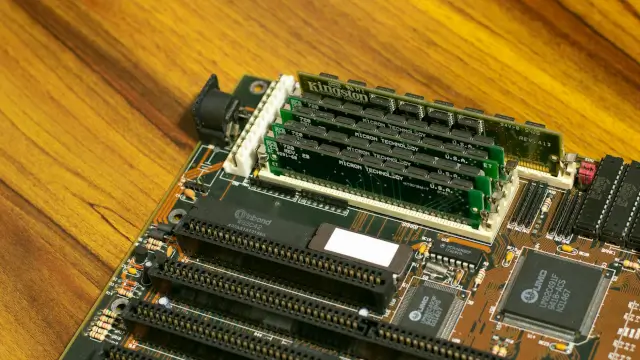
To understand why memory chips have become so valuable, you need to understand what HBM4 actually does. Traditional DRAM chips are arranged flat on a circuit board. HBM stacks memory dies vertically, connected by thousands of through-silicon vias, creating a compact package with dramatically higher bandwidth.
The transition from HBM3e to HBM4, documented at EETimes CES 2026 coverage, represents a fundamental architectural shift. HBM4 doubles the memory interface width to 2048-bit and integrates a logic base die — essentially adding computing capability directly into the memory stack. This enables up to 3.3 TB/s per stack, nearly triple the bandwidth of HBM3e.
The practical impact is enormous. AI training runs that once required weeks can now complete in days. Large language models with hundreds of billions of parameters can be served with lower latency. And the next generation of AI accelerators — NVIDIA's B300, AMD's MI400, and custom Google TPU v6 — all require HBM4 to deliver their promised performance.
As Micron's own product page describes it: "HBM4 gives artificial intelligence and scientific computing the memory to amplify what we can achieve. Picture reasoning models designing new medicines through millions of logical steps or researchers modeling planetary storms to understand Earth's climate."
The Numbers Behind the Rally: Micron's Financial Performance
Micron's financial performance in 2026 has been nothing short of extraordinary. The Q2 FY2026 results shattered records across every metric:
| Metric | Q2 FY2026 | Year-over-Year Change |
|---|---|---|
| Revenue | $23.86 billion | +196% |
| Non-GAAP EPS | $12.20 | Beat guidance by 45% |
| Gross Margin | 74.9% | Up from 56.8% |
| Operating Income | $16.45 billion | Record high |
| Q3 Gross Margin Guide | 81% | Continued expansion |
As CNBC reported, Micron's revenue almost tripled in the latest quarter as results topped analysts' estimates and guidance sailed past expectations. The company's FY2026 consensus revenue is approximately $76 billion — nearly double FY2025 — driven entirely by AI data center memory demand, according to Market Digests analysis.
Micron's forward price-to-earnings ratio sits at approximately 5.7x — an 80% discount to the semiconductor sector median. This makes it one of the cheapest valuations in large-cap tech, despite the explosive growth. The disconnect between Micron's valuation and its earnings trajectory is what prompted UBS's dramatic price target revision.
Why UBS Tripled Its Price Target to $1,625
The UBS upgrade that triggered Micron's trillion-dollar leap was anchored in a fundamental reassessment of the memory chip industry's growth trajectory. Analyst Timothy Arcuri, consistently ranked among the top semiconductor analysts on Wall Street, argued that the AI memory supercycle is accelerating faster than previously modeled.
As TIKR's analysis detailed, UBS just raised its Micron price target from $535 to $1,625, sending shares up 19.29% and pushing MU past a $1 trillion market cap. The upgrade reflected UBS's view that memory chip pricing power will remain elevated through 2027 as AI infrastructure spending continues to accelerate.
The logic is straightforward: every NVIDIA H100, H200, and B200 GPU requires multiple HBM stacks. Every new AI data center requires hundreds or thousands of these GPUs. And every hyperscaler — Microsoft, Google, Amazon, Meta — is spending tens of billions annually on AI infrastructure. Memory is the bottleneck, and Micron is one of only three companies on Earth that can supply it.
The memory chip shortage is already impacting consumer electronics. As TechTimes reported, AI memory chip stocks from Micron, SK Hynix, and Samsung crossed $1 trillion each in May 2026, creating a combined $3 trillion oligopoly. The same HBM shortage driving their valuations is causing smartphone prices to increase by approximately 14% in 2026.
The Memory Chip Shortage: Who's Winning, Who's Paying
The AI memory boom has created winners and losers. The winners are obvious: Micron, SK Hynix, Samsung, and their shareholders. The losers are less visible but equally real — consumer electronics manufacturers, smartphone makers, and ultimately consumers who are paying higher prices.
According to Tech Insider analysis, Samsung, SK Hynix, and Micron have collectively shifted 93% of their combined market production toward HBM for AI data centers, leaving only a fraction of output for general-purpose RAM used in consumer devices. This concentration of production capacity is driving up prices across the entire DRAM market.
As IEEE Spectrum documented, the DRAM shortage extends beyond AI. Micron, Samsung, and SK Hynix combined make up the vast majority of the memory and storage markets, and all three have new fabs and facilities in the works. However, these are unlikely to meaningfully increase supply until 2027 at the earliest.
Cycle-Peak Risk: Is the Memory Boom About to Bust?
For all the euphoria, a critical question looms: is the memory chip industry approaching cycle peak? Memory chips have historically been one of the most cyclical segments of the semiconductor industry, with boom-and-bust patterns that have punished investors who bought at the top.
As Seeking Alpha's detailed bear case argued, "Micron hits record AI-driven revenue, but peak-cycle pricing, rich valuation, and $20B FY2026 CapEx raise oversupply risk." The bear case centers on three concerns: first, that $25+ billion in annual capex spending across the industry could lead to oversupply; second, that memory pricing is cyclical and will eventually normalize; and third, that AI spending may decelerate as hyperscalers digest their current infrastructure investments.
The bull counterargument is that this cycle is fundamentally different. Unlike previous memory cycles driven by PC and smartphone demand, the AI supercycle is structural and multi-year. Hyperscalers are signing multi-year binding contracts for HBM supply — not spot purchases. As S&P Global Market Intelligence noted, strong guidance and robust DRAM and HBM outlooks have prompted analysts to sharply raise near-term revenue and profit forecasts.
The reality likely lies somewhere between. AI memory demand is real and growing, but the industry's $58+ billion in aggregate capex spending creates the potential for oversupply by 2027–2028. Investors should watch for signs of demand deceleration, particularly in hyperscaler capital expenditure reports and NVIDIA's forward guidance.
What Investors Should Watch Next
The memory chip oligopoly is reshaping investment strategy across the semiconductor sector. Here are the key signals to monitor:
- Micron's Q3 FY2026 earnings (June 2026): The 81% gross margin guide will be the key test. Any shortfall could trigger a sharp sell-off.
- Hyperscaler capex reports: Microsoft, Google, Amazon, and Meta earnings in July will reveal whether AI infrastructure spending is accelerating or decelerating.
- HBM4 production ramp: Any delays in HBM4 mass production could extend the supply shortage and benefit current HBM3e pricing.
- Chinese memory chip development: CXMT and other Chinese DRAM makers are investing heavily. Any breakthrough could disrupt the oligopoly.
- Memory pricing trends: DRAM spot prices are the canary in the coal mine. Declining prices signal the cycle is turning.
Conclusion
Micron's $1 trillion market cap milestone marks a turning point in the semiconductor industry. The AI-driven HBM boom has transformed memory chipmakers from cyclical commodity producers into strategic infrastructure providers. Samsung, SK Hynix, and Micron now form a $3 trillion oligopoly that controls the most critical component of AI computing.
The investment thesis is compelling: 700% stock gains, 75% gross margins, fully sold-out 2026 capacity, and a UBS price target of $1,625. But the risks are equally real. Memory is cyclical, capex is soaring, and the $58 billion industry-wide investment could create oversupply by 2027.
For investors, the memory chip oligopoly represents both opportunity and danger. The AI supercycle is real, but so is the memory cycle. The companies that navigate the transition from HBM3e to HBM4 without losing pricing power will define the next decade of AI infrastructure. The others will become cautionary tales.
Last Updated: May 29, 2026 | Source: Bloomberg, Reuters, CNBC, Yahoo Finance, UBS Research (Official Websites)